


About Dr. Chirag Jain
Advancing Cancer Care Beyond the Disease
“We had built extraordinary machines to treat the tumour. But in that chair, with the machine humming, the patient was completely alone with their fear.”Dr. Chirag Jain
Advancing Cancer Care Beyond the Disease
1 in 4
Cancer patients clinically suffer from severe anxiety.
31%
Anxiety incidence specifically documented among women under oncology treatment.
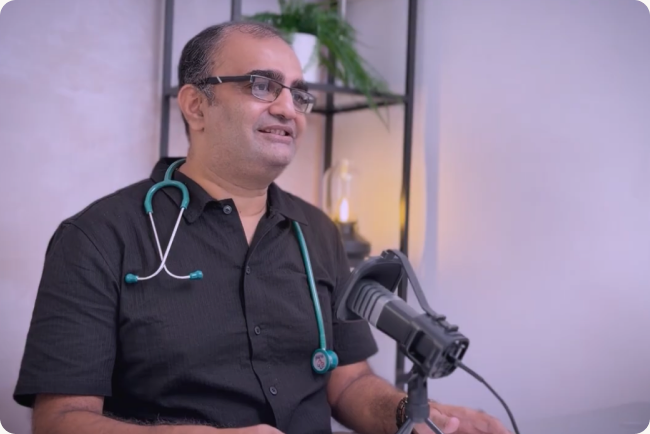
These words reflect a reality experienced by many people throughout the cancer journey. Despite remarkable advances in cancer diagnosis and treatment, anxiety remains one of the most prevalent yet under-recognised psychological comorbidities affecting patients. A meta-analysis of 84 studies found that approximately one in four people living with cancer experience anxiety symptoms or anxiety disorders, with the prevalence approaching 31% among women diagnosed with cancer. (Amiri S, 2024, Frontiers in Psychiatry.) A cancer diagnosis can bring uncertainty, fear, and countless unanswered questions. Patients may worry about their treatment, their future, their family, and the life that lies ahead. For many, these concerns develop into persistent anxiety that affects psychological health, treatment confidence, decision-making, and the overall experience of care. At the heart of Dr. Chirag Jain's work is a simple yet important belief: Comprehensive cancer care should address not only the disease but also the psychological impact that accompanies the cancer journey. This belief has inspired his commitment to advancing awareness of Onco-Anxiety—the anxiety experienced throughout the cancer journey—and supporting the emerging research framework of Onco-Anxiology, which seeks to understand, measure, and address anxiety across different stages of cancer care through scientific investigation. Rather than replacing medical treatment, the objective is to complement it through education, clinical research, and evidence-based innovation that contribute to a more comprehensive approach to cancer care.
“Comprehensive cancer care should address not only the disease but also the psychological impact that accompanies the cancer journey.”
The Story Behind This Work
Every meaningful journey begins with a question.
Psychological distress is common among people living with cancer, yet it remains under-recognised and under-reported in routine oncology practice despite recommendations for systematic distress screening.
Reference: Use of the Distress Thermometer in Clinical Practice, PubMed Central
- 1
A question that would not settle
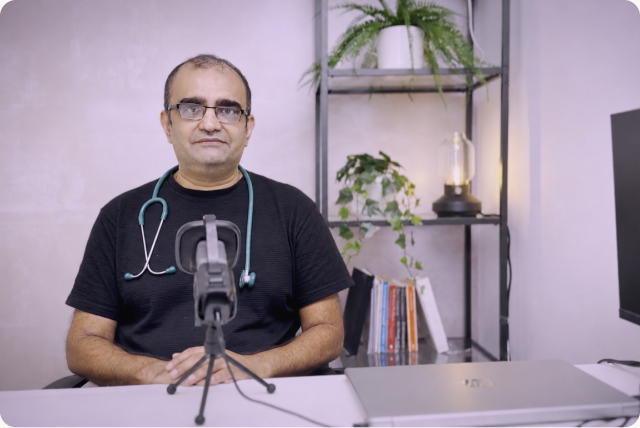
For Dr. Chirag Jain, that question was not only how cancer could be treated more effectively, but also how patients could be better supported through the psychological challenges they experience from diagnosis to recovery.
- 2
Eighteen years of observation
Across more than 18 years of clinical practice, he observed that while remarkable progress had been made in treating cancer, many patients continued to face an invisible struggle—one that was rarely measured, openly discussed, or consistently addressed within routine care.
- 3
An under-recognised burden
The psychological burden associated with cancer can influence sleep, confidence, treatment decisions, family relationships, and quality of life. Yet it frequently remains overshadowed by the physical aspects of the disease.
- 4
A new direction
Recognising this gap led to the development of Onco-Anxiology—an emerging research framework dedicated to understanding anxiety throughout the cancer journey and exploring evidence-based approaches that may improve the overall patient experience.
Today, this work continues through research, education, innovation, and public awareness with the aim of encouraging a broader understanding of psychological health as an essential component of comprehensive cancer care.
Meet Dr. Chirag Jain
Dr. Chirag Jain, MBBS, is a physician, researcher, author, innovator, and Co-Founder of Mindful Gurukul Pvt. Ltd. More than 18 years of clinical experience have shaped his professional journey, guided by a commitment to improving patient care through science, research, and responsible innovation.
His work brings together clinical medicine, neuroscience, behavioural science, and technology to better understand the relationship between cancer and anxiety. By advancing Onco-Anxiology as an emerging area of clinical research, Dr. Jain seeks to encourage greater scientific recognition of an aspect of cancer care that has historically received limited attention despite its measurable impact on patients and their families.
His vision extends beyond raising awareness. Through carefully designed clinical research and evidence-based innovation, he aims to contribute meaningful scientific evidence that may support future approaches to psychological care within comprehensive oncology practice.

Research That Puts Patients First
Every initiative undertaken by Dr. Chirag Jain is grounded in one principle:
Innovation must always be supported by scientific evidence.
Current research investigates the role of Heart Rate Variability (HRV)—a validated physiological marker of autonomic nervous system activity—in improving the understanding of anxiety experienced during the cancer treatment journey.
A registered randomised controlled clinical trial is currently underway in patients undergoing radiotherapy and chemotherapy. The study evaluates treatment-related anxiety, health-related quality of life, treatment adherence, and physiological parameters to better understand anxiety during cancer care.
Rather than introducing new clinical approaches before sufficient evidence is available, this research follows a structured pathway of clinical observation, scientific evaluation, and transparent reporting.
This research-first philosophy reflects Dr. Chirag Jain’s commitment to responsible medical innovation—where every hypothesis is tested through rigorous scientific methodology before informing future clinical practice.
Trial Registration
CTRI/2025/11/116732
Registered with the Clinical Trials Registry — India. A randomised controlled trial in patients undergoing radiotherapy and chemotherapy.

Clinical observation
Anxiety experienced during treatment is observed and documented within real clinical settings.

Scientific evaluation
Hypotheses are tested through validated physiological markers and rigorous trial methodology.

Transparent reporting
Findings are registered, reported, and shared before informing future clinical practice.


Research, Publications & Innovation

Every research project, publication, and innovation reflects a shared objective— to advance the scientific understanding of Onco-Anxiology and contribute to a more comprehensive approach to cancer care.

Beyond clinical practice, Dr. Chirag Jain’s work spans clinical research, scientific authorship, healthcare innovation, and medical education. Each milestone contributes to the broader goal of improving the understanding of treatment-related anxiety and supporting evidence-based advances in comprehensive cancer care.
Publications
Knowledge plays an essential role in advancing healthcare. Through his books, Dr. Chirag Jain has explored neuroscience, resilience, learning, and the emotional dimensions of health, making complex concepts more accessible to readers.
Book
Overview
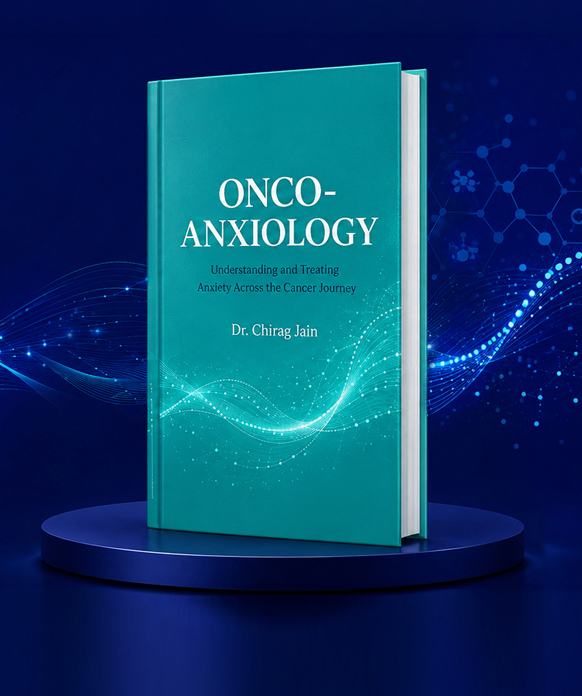
Onco-Anxiology
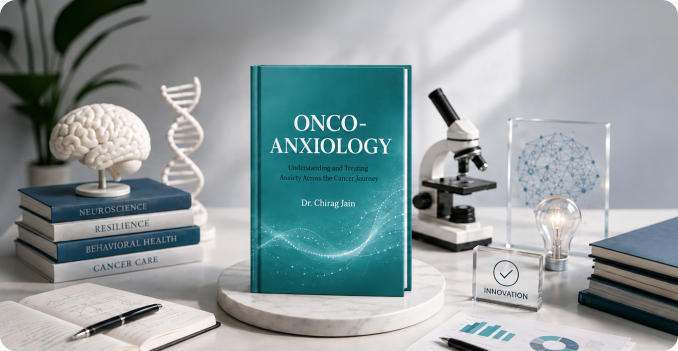
ForthcomingExamines anxiety across diagnosis, treatment, and survivorship and sets out Onco-Anxiology as an emerging research framework focused on the cancer journey.
Innovation & Patents
Innovation has always been guided by one principle: solving meaningful healthcare challenges through scientific thinking.
Innovation
Status

Method of Identification of Distractions for Study or Work Environment
Granted PatentPatent No. 563614
Method for Monitoring the Focus State of an Individual in Real Time
Granted PatentPatent No. 558041
System and Method for AI-Based Adaptive Emotion Regulation
International PCT FilingFiled across five countries, supporting ongoing research in adaptive emotional regulation.
Speaking & Media
Scientific knowledge becomes more valuable when it is shared with the wider community.
Platform
Contribution
TEDxGateway
Talk
Delivered a talk exploring how the brain changes through neuroplasticity and how understanding the mind can influence personal growth and learning.
CNBC Awaz
Television Series
Featured in a television series named “Consumer Adda” discussing focus, learning and the science of changing the way we think.
What This Work Stands For
The long-term goal of this work is to advance a future where psychological health is recognised as an essential component of comprehensive cancer care, ensuring that anxiety experienced throughout the cancer journey receives the scientific attention, clinical understanding, and evidence-based support it deserves.
This commitment is pursued through ethically conducted clinical research, responsible innovation, and evidence-based education. By advancing the emerging field of Onco-Anxiology, the aim is to improve scientific understanding of cancer-related anxiety while encouraging greater awareness among patients, caregivers, healthcare professionals, researchers, and policymakers.
Every research initiative, educational resource, and collaborative effort is guided by scientific integrity, transparency, and a commitment to meaningful patient outcomes. As evidence continues to evolve, the focus remains on contributing credible research that supports a more comprehensive, patient-centred approach to cancer care—where emotional health is recognised not as a secondary concern, but as an integral dimension of oncology practice.
The Principles Behind This Work
01
Compassion
Every cancer journey is unique. The work is guided by empathy, dignity, and respect for patients, caregivers, and families navigating the challenges of cancer diagnosis, treatment, and survivorship.
02
Scientific Integrity
Clinical research, ethical practice, transparency, and methodological rigour form the foundation of every initiative. Healthcare innovation should always be supported by credible scientific evidence.
03
Education
Evidence empowers informed decision-making. The commitment is to translate complex medical and scientific concepts into accurate, accessible, and evidence-based educational resources for patients, caregivers, and healthcare professionals.
04
Innovation
Innovation should always follow evidence—not precede it. Every new concept or intervention is explored through structured clinical research before being considered for broader application.
05
Collaboration
Meaningful progress in healthcare depends on collaboration among clinicians, researchers, patients, caregivers, academic institutions, and healthcare organisations working towards a shared goal of improving cancer care.
Emotional health is not a secondary concern — it is an integral dimension of oncology practice.

Join the Journey
Advancing comprehensive cancer care requires collaboration across research, clinical practice, education, and public awareness.
Whether you are a patient, caregiver, healthcare professional, researcher, or institutional partner, your engagement contributes to a broader understanding of anxiety during the cancer journey and supports the ongoing evolution of evidence-based cancer care.
Explore the research, learn more about Onco-Anxiology, and join us in advancing meaningful conversations about the role of psychological health in comprehensive cancer care.
